 Back to Blogs
How to Develop a Process for Adapting your Plan Throughout the Year

A marketing plan is not a contract. It’s a hypothesis.
It represents the best thinking of the team at a single point in time, built on assumptions about market conditions, competitive dynamics, budget availability, and organizational priorities. Some of those assumptions will hold. Many will not. The question isn’t whether your plan will need to change. It’s whether your team has the process to change it intelligently.
What forces a marketing plan to change
Plan changes typically come from one of two directions: internal shifts and external ones.
Internal changes include:
- A budget increase that creates room for new programs or expanded investment in high-performing channels
- A budget cut that requires rapid prioritization and reallocation
- A leadership change that shifts strategic priorities mid-year
- A headcount change that affects execution capacity
External changes include:
- A competitor launching a new product or entering a new market
- A new regulation that affects how you can market or who you can reach
- A macroeconomic shift that changes buyer behavior or appetite
- An unexpected market opportunity that wasn’t visible during planning
Any of these can render parts of the original plan obsolete or create new opportunities that the plan didn’t account for. The teams that respond well aren’t the ones with the most resources. They’re the ones with the best process.
Why most teams struggle to adapt
The challenge isn’t recognizing that the plan needs to change. Most marketing leaders can see that clearly enough. The challenge is executing that change quickly, confidently, and without creating confusion or misalignment across the team.
Three things typically get in the way:
Timing. By the time a new opportunity is identified, evaluated, and approved, the window has often passed. Slow decision-making processes turn good opportunities into missed ones.
Resources. Teams don’t always have a clear picture of where capacity exists. If you don’t know which programs have bandwidth to absorb new work, it’s hard to commit to anything new without risking execution quality across the board.
Budget. Without real-time visibility into planned, committed, and actual spend, it’s nearly impossible to know whether the budget exists to fund a new opportunity, or which existing programs would need to be adjusted to create room for it.
When these three constraints are visible and manageable, decisions that used to take weeks can happen in hours. When they’re not, teams default to passing on opportunities simply because the evaluation process is too slow and too uncertain.
Building a process for plan adaptation
Scenario planning gives marketing teams the ability to model potential changes before committing to them. Instead of reacting to change after the fact, teams can prepare responses in advance and evaluate trade-offs clearly when the moment arrives.
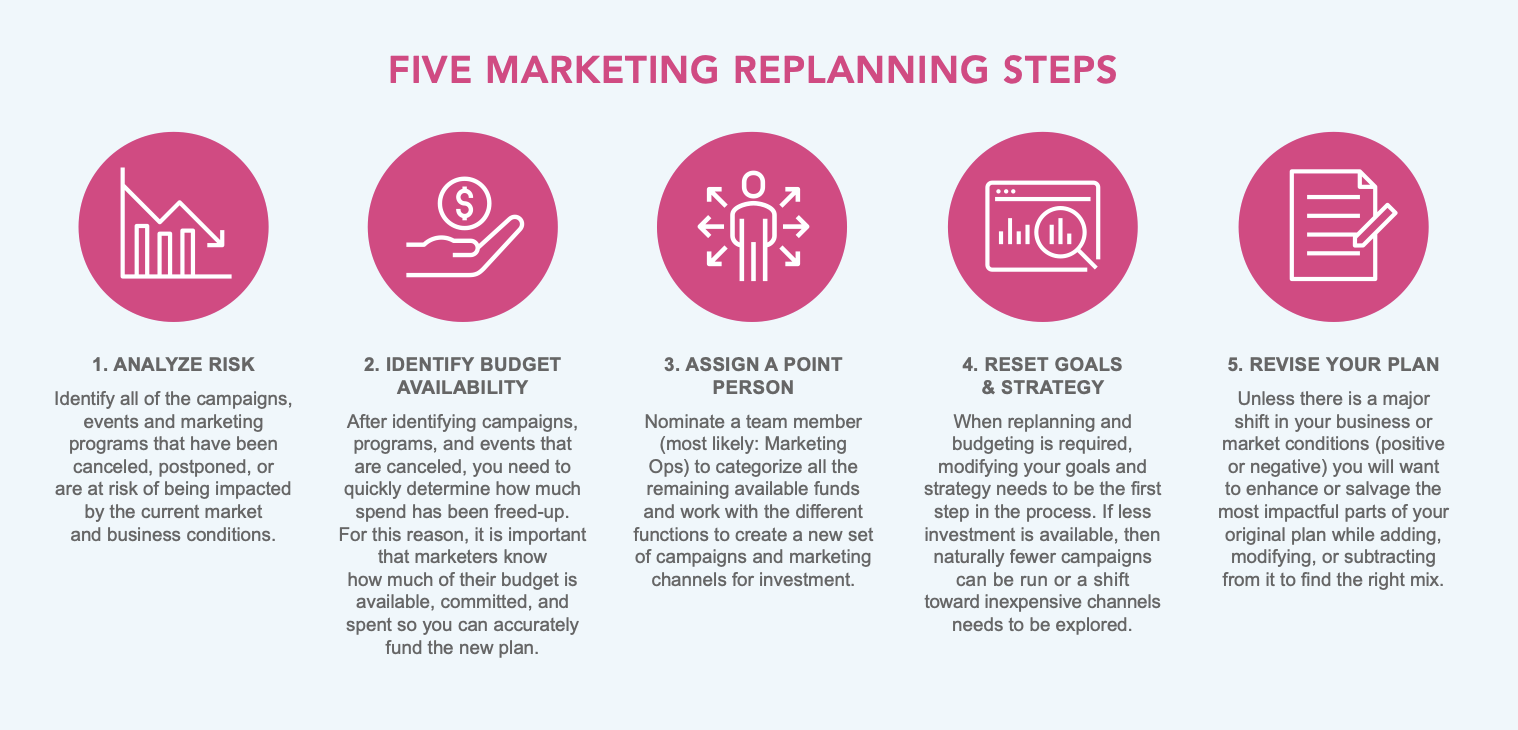
An effective plan adaptation process follows five steps:
1. Assess. Does the new opportunity or required change support the annual marketing goals? Is it executable given current resources and timelines? If the answer to either question is no, the evaluation stops here.
2. Prioritize. Compare the new opportunity directly against existing programs. Which will have more impact on the goals? This isn’t a gut-feel exercise. It requires visibility into current program performance and budget allocation so the comparison is grounded in data rather than opinion.
3. Collaborate. Plan changes that happen in a silo create misalignment across the team. Bring the relevant budget owners and stakeholders into the conversation early, so that any changes to the plan are understood and supported by the people responsible for executing them.
4. Reallocate. If the decision is made to pursue the new opportunity, move budget accurately and with full visibility into the downstream impact. This means closing or reducing existing campaign budgets formally, not just making a mental note to spend less elsewhere.
5. Re-engage. Once the immediate change has been made, return to the original plan and assess whether further adjustments are needed to stay on track toward annual goals. A single reallocation can have ripple effects that aren’t immediately obvious.
A word of caution on opportunistic planning
A process for plan adaptation is not a license for constant replanning. The risk of building too much flexibility into your planning culture is that urgent opportunities begin to crowd out the strategic programs that drive long-term results.
The discipline lies in distinguishing between opportunities that genuinely advance the annual goals and distractions that feel urgent but don’t. The evaluation process above is designed to make that distinction clear. If a new opportunity can’t pass the first step, it doesn’t warrant the disruption of changing the plan.
Flexibility and focus are not opposites. The best marketing teams hold both simultaneously: a clear commitment to the annual strategy and a well-practiced ability to adapt when the evidence demands it.
What this looks like with the right infrastructure
Scenario planning and plan adaptation are only as effective as the infrastructure that supports them. When budget, goals, and program performance live in disconnected systems, every adaptation decision requires manual reconciliation across multiple sources of data. That friction is what makes teams slow, conservative, and ultimately less competitive.
When everything lives in one place, the picture changes. Marketing leaders can model scenarios in real time, compare opportunities against current programs with confidence, and execute changes quickly without losing visibility into the original plan or creating confusion across the team.
Planful gives marketing teams exactly that infrastructure: a single, real-time system where plan, budget, and performance data are always connected, always current, and always accessible to the people who need to make decisions.
When the market moves, you’ll be ready to move with it.
See how Planful helps marketing teams build plans that adapt without losing focus. Get a demo today.
Key takeaways
- Fewer than 60% of marketers build scenario planning into their process, leaving most teams without a clear mechanism for responding to change intelligently.
- The three barriers to effective plan adaptation are timing, resources, and budget visibility. When all three are manageable, good decisions happen faster.
- A repeatable five-step process for evaluating, prioritizing, and executing plan changes is what separates teams that adapt strategically from those that simply react.
FAQs
What is scenario planning in marketing?
Scenario planning is the process of modeling potential changes to the marketing plan before they’re needed. It allows teams to prepare responses to likely events, such as budget cuts, competitor moves, or new opportunities, so that when change arrives, the evaluation and decision-making process is fast and grounded in data rather than guesswork.
How often should a marketing plan be reviewed and updated?
Marketing plans should be reviewed continuously, not just at the end of each quarter. Real-time visibility into budget and program performance allows teams to identify when the plan needs adjustment early, before small variances compound into significant misses against annual goals.
How does Planful support marketing scenario planning?
Planful gives marketing teams a single, real-time system where plan, budget, and performance data are always connected. This makes it possible to model scenarios, compare opportunities against existing programs, and execute plan changes quickly and accurately without losing visibility into the original strategy.

Dan Faulkner is co-author of The Next CMO: a guide to operational marketing excellence, and the CTO of Planful, where he is responsible for the technical strategy and delivery of the world’s first AI-powered marketing management platform. Dan has 25 years of high-tech experience, spanning research and development, product management, strategy, and general management. He has deep international experience, having led businesses in Europe, Asia, North America, and South America, delivering complex AI solutions at scale to numerous industries. Dan holds a Bachelor’s degree in Linguistics, and Masters degrees in Speech & Language Processing, and Marketing. He has completed studies in Strategy Implementation at Wharton.

 Shore Capital exclusive event - Oct 15 @ [X:XX] AM ET: What Every Finance Leader Should Know About PE Reporting

