The New Operating Model for Finance, Explained
Your field guide to how today’s top finance teams actually run

Table of Contents

The world has shifted, and finance has to shift with it
Most finance teams will not discover their AI failed for 18 months. Through every cycle, the system looks fine, variances close, and board commentary reads sharper than it used to.
Then an auditor pulls a sample, or a restatement forces a look back, and the team finds an accumulation of small errors stitched into the close by a system everyone trusted because it was fast.
This is the cost the typical AI-in-finance pitch does not price. Finance is not AI’s slowest adopter. Rather, it’s AI’s hardest test, because finance is the only function where every output has a counterparty: an auditor, a board, a regulator, a prior commitment the business already made.
The teams that come through the next two years intact will not be the ones moving fastest. They are the ones building a finance operating model that their AI can actually run on, with definitions that hold across the cycle and ownership assigned at every layer.
Deloitte’s 4Q25 CFO Signals Spotlight put numbers to the gap. Sixty-three percent of finance teams have fully deployed AI solutions. Only 21% believe those investments have delivered tangible value. Only 14% have integrated AI agents directly into the finance function.
Source: Deloitte 4Q25 CFO Signals Spotlight; 2026 Finance Trends Report.
63%of finance teams have fully deployed AI solutions.
21%believe those investments have delivered tangible value.
14%have integrated AI agents directly into the finance function.
Source: Deloitte 4Q25 CFO Signals Spotlight; 2026 Finance Trends Report.
This guide is your field map.
"For us it kind of boiled down to trust. It wasn't that we didn't trust the numbers, it was we struggled trusting the output of what it was telling us. It wasn't in a structure in the way that we needed to view and speak of our business in order to support our business."
Why context is the unlock
Context is the boring word that decides whether AI in finance and accounting survives its first audit, and it is not about the model or the prompt.
The unlock is structured definitions, ownership, and lineage that let the same answer hold up in a board pack on Monday and a control test on Friday.
The temptation is to skip ahead. Buy the copilot, point it at the data lake, ship the demo.
Teams that took that route in 2025 are now spending Q2 of 2026 unwinding entries they cannot fully reconstruct because the system that wrote them did not run in the context the auditor recognizes.
- Compute gave us speed, and the spreadsheet replaced the calculator.
- Comprehend let machines read a contract or classify a transaction.
- Collaborate gave the blank page a partner.
- Context plugs AI into your specific finance environment: your chart of accounts, your close calendar, your forecasts, and your governance.
Context is the fourth. It plugs AI into the specific finance environment it works inside, including your chart of accounts, your close calendar, your forecasts, and your governance.
Context is the difference between a fast intern who does not know the business and an experienced analyst who has been on the team for years.
The Context Era is what lets context-aware AI deliver answers you can actually act on.
Why your finance team needs a new operating model
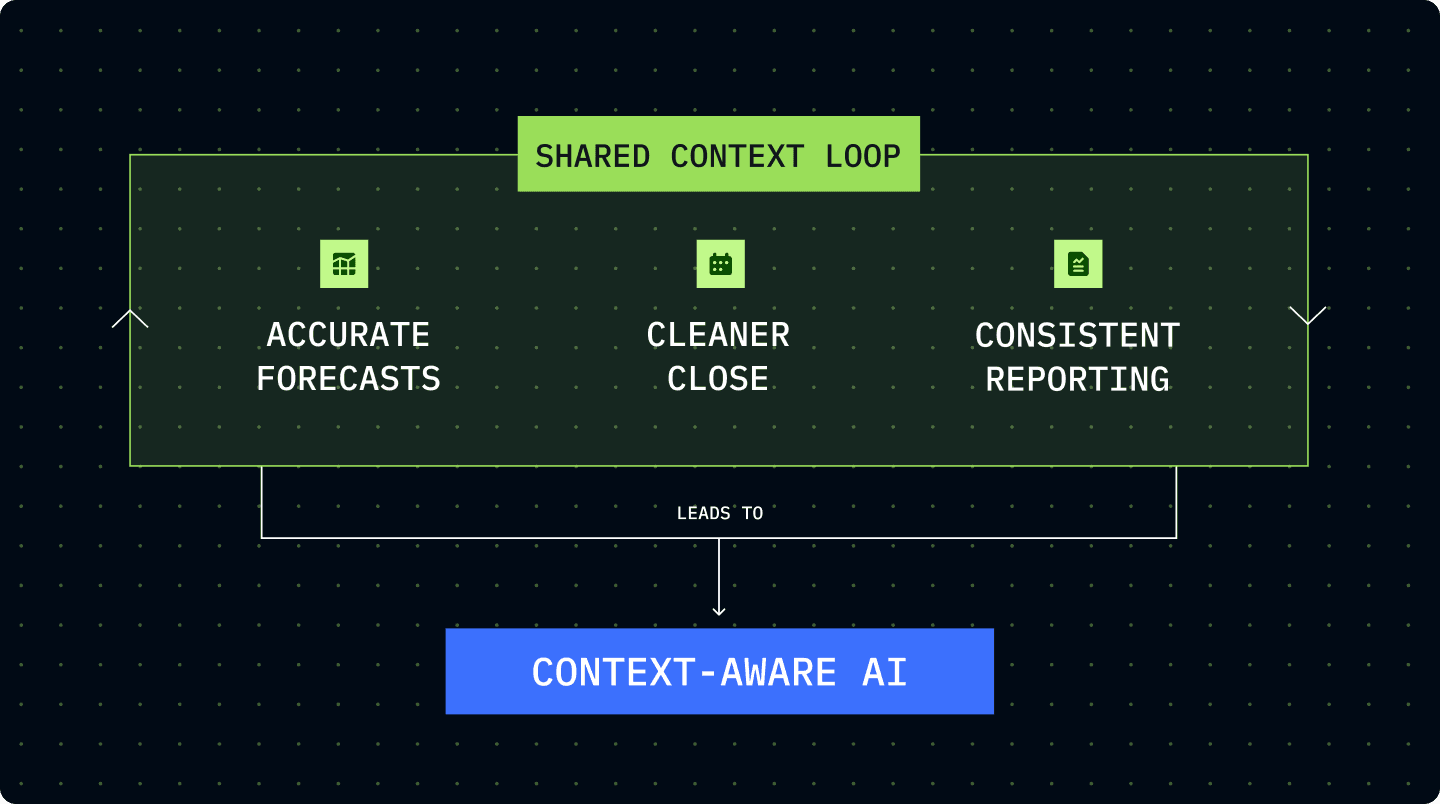
Finance is a loop, and your loop only compounds when it runs on shared context.
The Context Era is a software shift and an operating shift. You can’t run finance the way you ran it ten years ago and expect context-aware AI to behave like an experienced analyst.
The reason is structural. Every forecast, every close, and every board review your team delivers is part of one continuous loop.
- The numbers your team produces get reviewed.
- The reviews shift your assumptions.
- Your assumptions shape your next forecast.
- Every cycle should compound on the last.
Disconnected systems, scattered definitions, and unclear ownership force your team to rebuild the picture every cycle. AI in that environment also rebuilds it, and you end up paying for a generic answer.
When your loop runs on a shared context, every cycle gets sharper. Your forecasts get more accurate, your close gets cleaner, your reporting tells a more consistent story, and the context-aware AI you bring into the work inherits all of it. That’s what today’s top-performing finance teams are doing differently in 2026.
Inside the five layers of your finance loop
Each layer is real work that already lives on your team. The model connects the layers and gives context a place to live.
Layer 1: Your Foundation is the financial truth your business runs on
💡 TL;DR: The bedrock data, structures, and policies every other layer depends on.
This is the bedrock every other layer relies on:
- Your chart of accounts, with the entity structure that holds it across the business.
- The planning methodology your team operates on across structured, dynamic, and workforce planning.
- The accounting policy standards everything else has to follow.
- Ownership of the close calendar and the cadence it sets for the rest of the business.
Foundation is doing its job when structured plans, dynamic models, workforce data, and consolidations all share the same governed data model. Every layer above then works from the same numbers.
It’s also where the build-it-yourself instinct hits a ceiling that’s structural rather than a missing feature.
A data store shaped by the spreadsheet holds your numbers without understanding the relationships between them, the entity hierarchy, the eliminations, the multi-currency rules, and the single chart of accounts that has to hold across every plan and close. Product polish does not close that gap, because the gap is in the shape of the data model itself.
A purpose-built dimensional model understands those relationships natively, which is the difference between AI that can read your numbers and AI that can reason about your business.
“Before we had Planful, when we were able to prepare monthly group reporting, it ended like twenty working days to have the global one. But now working day seven, we have global draft. After review, working day twelve, hard close for everything clean. And bear in mind, it covers all of the business, over a hundred of the entities."
Layer 2: Your Intelligence is the signals you watch
💡 TL;DR: The early warning system that tells you something has changed and explains why.
This is where your model tells you something is changing:
- Actuals tracked against plan in flight, not after the month closes.
- Variance and exception analysis that names the driver, not just the gap.
- Scenario status visible while the assumption still has time to change the outcome.
The signal layer earns its keep when anomalies and forward-looking views surface automatically, and a natural-language question about what changed and why returns an answer that explains the drivers.
Gartner expects AI-driven decision tools to replace 60% of finance’s custom analysis by 2029, shifting finance teams from producing reports and models to interpreting algorithms and embedding insights inside business workflows. Intelligence is the layer where that shift either holds together or falls apart, depending on whether the AI knows the business it is interpreting.
"I’ve used it to quickly summarize ahead of a close meeting. What are the drivers that are most relevant, 10% or more on the P&L that I need to be aware of before going into the meeting, so that I’m not looking at every single variance. I can see what’s important and dig into those at a more detailed level to be prepared for that discussion."
Layer 3: Your Action is the work that produces the numbers
💡 TL;DR: The execution layer where planning, close, and consolidations all run on the same governed data.
- Budget and forecast running on the same data model, not parallel files.
- Consolidation that closes inside the same platform that the modeling lives in.
- A month-end close calendar that your modeling owners can see and plan around.
- Account reconciliations tied back to source ledger entries, not standalone tickmarks.
- Journal entries posted with the lineage that turns the auditor’s job into a five-minute walkthrough.
Action is where your FP&A operating model meets the calendar. It is doing the work when flexible driver-based modeling, employee-level workforce planning, and multi-entity close run on the same governed data, so the modeling and the close stay in sync.
"We were reviewing T&E spend for our strategic sales department. The analyst on my team went into the Planful tool, ran the AI forecast across all six GLs that roll up into our T&E. That information was then brought to our business partners. That's really the first time we actually used an AI output with our business partners to influence a decision."
Layer 4: Your Feedback is how performance gets reviewed
💡 TL;DR: The reporting and review layer that closes the loop and feeds the next cycle.
This is where your loop closes:
- Board and executive reporting that lands in the tools the audience already uses, not a one-off PDF.
- Forecast accuracy is tracked over time, so calibration is a number you can defend.
- Close quality metrics that the controller and the CFO read the same way.
- Driver calibration that feeds the next cycle, not just the next conversation.
"I’ve created a frequency of expectation. They know when they’re going to get their information. They know what they’re going to get for the information. They’ve tailored the presentation to their needs. They say, ‘Hey, Ben, can you add this to your presentation?’ We add it, and then the next month it’s there. They don’t need to come ask for ad hoc requests because it’s already in my presentation."
The loop closes when board-ready reporting lands in the tools your stakeholders already use, and AI-generated summaries do the first draft of the narrative, so your team refines the story instead of building it from scratch.
51%of CFOs are increasing their reporting cadence
45%are increasing forecast frequency
The faster cadence only holds up if the Feedback layer produces a narrative that your stakeholders can absorb at the same speed.
Source: 2026 AFP FP&A Benchmarking Survey Report: Integrated Planning.
"People trust the numbers. If you have a stakeholder like the board or the PE sponsor, and they ask specific questions where they want to go deeper, ‘How about this particular segment, can you drill down?’ And we can drill down now, and it makes sense.”
Layer 5: Your Orchestration is what keeps the model trusted
💡 TL;DR: The governance layer that scales trust as your model grows.
This is what scales governance with the rest of the model:
- SOX controls are built into the workflow, not bolted on at quarter-end.
- Segregation of duties holds whether a human or an AI agent is doing the work.
- Approval hierarchies that scale with the business, not the latest version of the org chart.
- Budget authority is delegated in the model itself, so the next forecast cycle inherits the rules.
Without governance built in, the four layers above will eventually break. When role-based access, audit trails, and approval workflows are built into the platform, trust scales with your AI model instead of struggling to catch up to it.
In February 2026, COSO, the internal-control framework your SOX program already runs on, published Achieving Effective Internal Control Over Generative AI.
The publication applies COSO’s five-component model, control environment, risk assessment, control activities, information and communication, and monitoring activities, directly to generative AI. Orchestration is the layer where finance AI either meets that framework or eventually fails an audit against it.
Source: COSO, Achieving Effective Internal Control Over Generative AI
"We had a really interesting case come up recently where, due to a slight reorganization of responsibilities, there was one user who was previously responsible for a completely different area of the business. She will go into Planful, she can look at a dashboard, she can ask a question to AI, she can go into the template we’ve created for her, and all she sees are her accounts. You can trust that wherever they go within Planful, the guardrails are there."
Context is the through-line that connects every layer
Without context, your layers are five separate workflows. With context, they become one operating model. Each cycle compounds on the last because the same definitions, the same ownership, and the same numbers carry through every step of the loop.
Three practices that keep your loop running
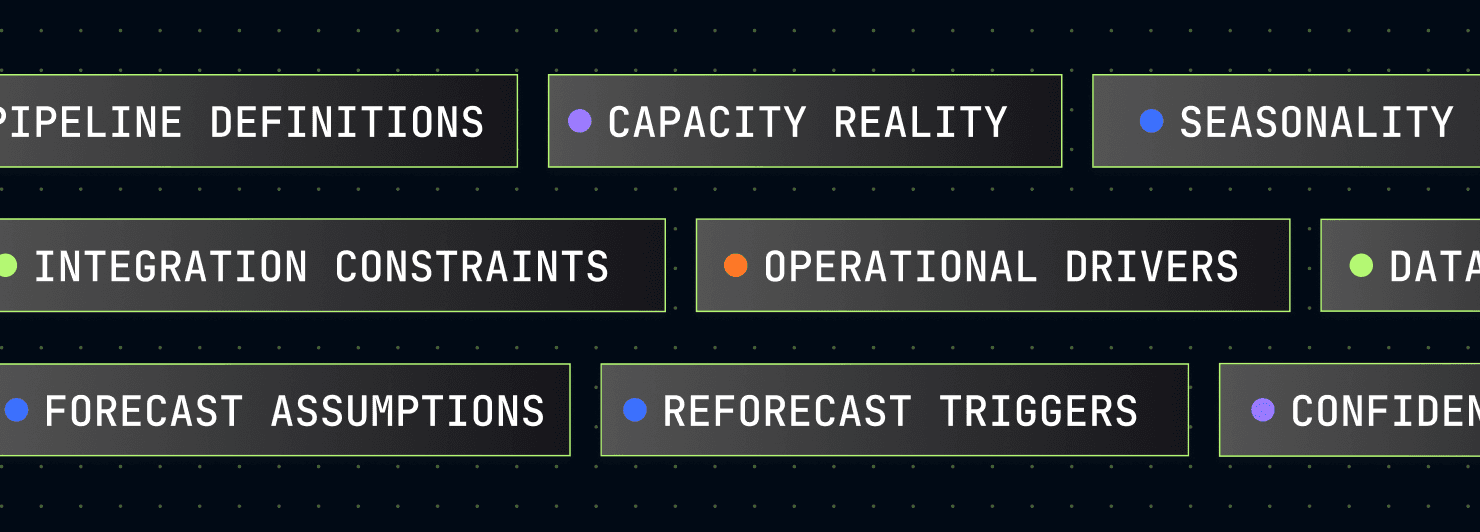
Shared definitions, decision rights, and narrative cadence hold the model together.
A five-layer operating model without these three practices is a diagram. It will not survive a real audit cycle, and it will not deliver the AI uplift you bought the platform for. Each practice closes a specific failure mode that shows up when the loop runs without context.
Most finance organizations recognize at least one of the three failure modes. Two teams sit in the same meeting and treat a metric like coverage ratio or gross margin as if they share the same definition, then discover at quarter-end they were calculating it differently the whole time. A variance gets flagged, surfaces to a leadership review, and dies there because no one was named as the owner of the decision. The MBR deck gets rebuilt from scratch every cycle because the format keeps shifting, and stakeholders learn that the real update happens in the room, not in the document.
Shared definitions, decision rights, and narrative cadence each close one of those failure modes.
PracticeWhat it means in your operating model
Shared definitionsEvery metric in every layer has one agreed-upon definition, one owner, and one authoritative source.
Decision rightsFor every signal your Intelligence layer raises, a named individual owns the call, a defined threshold triggers it, and an agreed escalation path keeps it moving.
Narrative cadenceEvery Feedback cycle communicates a consistent story about the state of the business, and every update answers the same questions in the same format.
Govern your definitions so context stays consistent
Pick the five metrics that come up most often in executive conversations. Ask three people from different functions to define each one independently. The number of different answers you get is your baseline context risk.
For each metric, document the following:
What to documentWhy it matters
Metric name and all common aliasesDifferent teams often use different names for the same concept. Capturing all of them prevents confusion when the same metric appears under different labels.
Exact formula, including what is included and excludedThis is where most definition gaps live. Two people can agree on the name of a metric and still calculate it differently.
One named ownerOne person needs to own the definition and resolve disputes when they arise.
Where the authoritative number livesIf people can pull the same metric from multiple systems and get different results, your governance is incomplete.
How often the metrics updatesStakeholders need to know when to expect a refresh, so they are not making decisions on stale data without realizing it.
Which decisions the metric informsConnecting each metric to the decisions it supports keeps the governance work grounded in practical use.
How the metric is commonly misreadMost metrics have a known failure mode. Documenting it proactively prevents recurring debates.
When your hierarchies, aliases, and segment structures stay consistent across your planning, workforce, and consolidations work, your governance lives where your numbers live, and your definitions hold up cycle after cycle.
"We deployed a variance analysis report where we’re actually sourcing the data directly from Planful to a Spotlight Excel report, and we’re letting the regions categorize their variances into set categories. It gives a completely different way of telling the story. In our business, it’s what variances do to rate, what variances do to adjusted growth, hiring more or less than planned, what variances are driven by productivity, and your standard OpEx variances."
Define ownership and thresholds, so signals lead to decisions
Your Intelligence layer surfaces signals. Your model only delivers value when those signals lead to decisions. For every significant analysis, three things need to be in place before you share it:
- One accountable decision-maker. A named individual who owns the call. Other people contribute perspective, and one person is responsible for the decision. When accountability is diffuse, decisions stall.
- A defined action threshold. The specific point at which a result moves from something you monitor to something you act on. For example, if gross margin falls below 42%, your pricing review process is triggered. When the threshold is pre-agreed, the decision to act does not require a separate conversation.
- A clear escalation path. When a decision stalls, a defined process moves it forward, so analysis does not sit unresolved while your business waits.
Signal detection can carry the threshold work for you, flagging variances the moment they cross a level you have defined. A planner assistant lets your decision-maker explore the impact of acting in plain language, so they are not waiting on a separate model run to make the call.
"You can actually really allocate people 20% to this facility, 30% to this facility. We have employees working at multiple sites on a normal basis. That really allowed us to have that level of granularity. Our HR team felt better about managing our workforce because they actually had real detail behind it."
Your Feedback layer only sharpens the model when your stakeholders absorb what it produces. Every financial update should answer five questions, in this order:
QuestionWhat it covers
What changed?Results versus plan, with the most significant variances identified.
Why did it change?The specific drivers behind the variances and the assumptions that explain them.
What does it mean for the business?What is at risk, what is on track, and what has changed in the outlook.
What are we doing about it?Decisions that have been made or need to be made, with named owners and timelines.
What are we watching next?The leading indicators that will signal whether the situation is improving before it shows up in the next set of results.
When your stakeholders know what to expect from every finance communication, they spend less time orienting to the format and more time absorbing the content. AI-generated summaries can pre-draft the answers to these five questions, so your team refines the story instead of building it from scratch.
How your loop creates alignment across the business
One operating model, every function plugged into the same context.
When you run finance on the new operating model, the rest of your business runs in lockstep. Each function plugs into the same context your team relies on, and the friction that used to slow decisions disappears.
Sales and finance defend the same forecast
Your finance team builds forecasts on assumptions about pipeline conversion, deal size, and sales cycle. In the new operating model, those assumptions live in a shared context layer, and sales co-owns them from day one.
It helps to see where the two functions live. Sales work in activity, meetings, and qualified leads, while you work in the reported numbers, bookings, ARR, and gross margin. The pipeline sits between them, and that is where the two sides are supposed to meet, and rarely do so cleanly. The forecast assumptions are the bridge across that gap.
Finance and sales agree upfront on:
- The conversion rate applied to your current pipeline
- The coverage ratio your forecast needs to stay credible
- The signal that triggers a revision, like coverage dropping below the threshold
Once inputs are shared, the conversation shifts from “is the number right” to “what do we do about it.” Assumptions get modeled in one place, and signal detection flags the moment one breaks.
That is what breaks the discounting spiral most finance leaders know, where reps sandbag, finance marks the pipeline down to be safe, leadership marks it down again, and everyone ends up steering on a number no one believes. The discounting only starts when the two sides work from different assumptions.
HR and finance describe the same workforce
Headcount is where finance and HR misalignment costs the most. A single $180k role left unfilled for two quarters can create roughly $90k in salary variance, before you account for lost productivity, delayed work, and missed opportunity.
The root cause is definitional. Finance models approved headcount. HR tracks a blend of approved, pending, and conditional roles.
When both teams work from the same Foundation layer, they describe the same workforce. Employee-level modeling for comp, capacity, and approval status lets variance show up in your model before it hits your P&L.
Operational signals reach your plan in time to act
Your operations teams generate signals you need to act on. A production delay, inventory shortfall, or fulfillment backlog can be visible to ops weeks before it lands as a revenue miss.
When operational metrics flow into your Intelligence layer within the cycle, you can model the impact while there is still time to act. Operational drivers belong in your financial model, and signal detection should catch anomalies before they turn financial.
What strong alignment unlocks for you
What finance gets back when the operating model holds.
You spend time on the work that requires your expertise
When definitions are unclear, you explain numbers that should speak for themselves. When ownership is fuzzy, your analysis gets reworked. When communication is inconsistent, stakeholders flood you with follow-ups. A tighter update would have answered.
That time is recoverable. Finance teams running the new operating model redirect it toward the analytical and strategic work that actually needs financial expertise
Your organization makes decisions at the pace your data supports
When stakeholders trust the numbers, know who owns the next step, and get consistent updates on the business, the gap between knowing and acting disappears.
Pricing decisions stop drifting, resource allocation questions get answered with conviction, and strategic initiatives that have been waiting on a financial read finally move forward.
💡 Finance becomes the function that the rest of the business leans on
The finance teams with the most influence are the ones every other function leans on for a clear, consistent, and trustworthy read on the business. You build that reputation metric by metric, update by update, and decision by decision.
Your next 30 days, week-by-week
Four weeks to sharpen the loop your team already runs on.
The five layers of your operating model are already moving inside your team every day. The next 30 days give you four focused vantage points on that loop, so your forecasts tighten, your close cleans up, and the partners around you know exactly what finance can do for them.
WeekYour vantage point
Week 1Trace a recent cycle. Walk your last forecast or close through the five layers. You'll see where work moved cleanly, where it stalled, and where context got dropped between hands. That trace becomes your map for the month.
Week 2Tighten your shared context. Identify the definitions, owners, and source-of-truth files your team leans on most. Flag every spot where the same term means different things across teams, or where a change in one layer never reached the next. Close the highest-impact gaps first.
Week 3Sharpen the story you tell. Take one recurring touchpoint, like your MBR or forecast call, and reshape it around the five-question narrative: what changed, why, what it means, what you're doing, and what you're watching next. Your audience absorbs more, asks sharper questions, and trusts the numbers faster.
Week 4Put the loop to work on a real decision. Pick a cross-functional question your business is wrestling with right now, like pricing, headcount, or pipeline coverage. Bring your partners into the layers your team operates in, show them the shared context behind your view, and let finance carry the call forward.
How Planful holds your operating model together
A platform that was built for finance before AI arrived.
A platform decision in finance is a decision about whose data model your business will run on for the next ten years, and which AI solutions for finance will run on top of it. Most platforms in this space were built to plan and are now retrofitting for AI. Planful has had the full finance stack in production for 20 years, so the AI sits on top of infrastructure that was already governed.
That governed foundation carries through to every layer of the loop:
- Your Foundation stays solid. Structured Planning, Dynamic Planning, Workforce Pro, and Consolidations work from the same governed data model.
- Your Intelligence gets sharper. Planful AI Signals catches anomalies the moment they cross a threshold, and Planful AI Analyst explains what changed and why in natural language.
- Your Action moves faster. Planful AI Planner generates projections and explores scenarios through chat. Dynamic Planning and Workforce Pro run on the same governed data, so your modeling, headcount planning, and close stay in sync.
- Your Feedback closes the loop. Spotlight delivers board-ready reporting in Excel, PowerPoint, and Word, with AI-generated summaries drafting the first version of your narrative.
- Your Orchestration stays trusted. Built-in approvals, audit trails, and role-based access scale your governance with your business.
The teams that get this right do not look transformed; they look unhurried. Their forecasts hold up across the cycle, the close finishes on time, and when the board sees the numbers, the story matches the one they heard last quarter. The auditor finds what they expect to find.
That is the win the operating model produces. The team holds its composure across the whole cycle, because the same context carries through every layer.
Turn this guide into your next quarter. Get started with Planful at planful.com/demo.
FAQs about new finance operating models
What is a finance operating model?
A finance operating model is the connected system, Foundation, Intelligence, Action, Feedback, and Orchestration, that lets a finance team’s data, ownership, and definitions carry through every forecast, close, and board review instead of resetting each cycle. It’s what lets AI in finance run on consistent context instead of guessing.
Why do finance operating models break down?
Most finance operating models fail not because the five-layer structure is wrong, but because the three practices that hold it together, shared definitions, decision rights, and narrative cadence, are missing. Without them, the same metric gets calculated differently across teams, and AI adoption in finance inherits that inconsistency instead of correcting it.
Is an FP&A operating model the same as a finance operating model?
An FP&A operating model usually covers planning, forecasting, and budgeting inside one function. A full finance operating model is broader: it also connects close, consolidations, reporting, and governance, so FP&A work runs on the same shared context as the rest of the finance loop instead of its own separate data set.
What does a new operating model for modern finance actually change?
A new operating model for modern finance replaces five disconnected workflows, planning, monitoring, execution, reporting, and governance, with one loop that runs on shared context. Instead of every cycle starting from scratch, forecasts, closes, and AI-generated insights all draw from the same definitions and ownership, so each cycle compounds on the last.
How does a finance transformation framework support AI adoption in finance?
A finance transformation framework defines the metrics, owners, and thresholds that let AI move from a pilot to daily use. Without that framework, AI in finance stalls at proof-of-concept, because the definitions behind the numbers were never standardized in the first place.


 Shore Capital exclusive event - Oct 15 @ [X:XX] AM ET: What Every Finance Leader Should Know About PE Reporting

