AI for Financial Consolidation

Table of Contents

AI for Financial Consolidation: An Overview
Finance teams today have a growing opportunity to elevate the speed, accuracy, and strategic value of their financial close processes. With AI enhancing today’s consolidation workflows, teams can now scale beyond the traditional manual processes and focus on delivering better, more intelligent insights to business leaders in a shorter amount of time.
AI in financial consolidation is simplifying workflows, improving data quality, and accelerating insights across the month-, quarter, and year end close.
What is AI for Financial Consolidation?
AI for financial consolidation is the use of machine learning, automation, and predictive technologies to streamline and enhance consolidation processes. These capabilities are integrated into current financial consolidation software, consolidation accounting software, and other financial close and consolidation solutions, helping teams unify data, automate tasks, validate results, and accelerate reporting.
Instead of finance teams spending hours reconciling data from multiple entities, AI can classify entries, detect anomalies, recommend corrections, and surface potential risks. AI tools for financial consolidation and close allow teams to focus on analysis rather than mechanics.
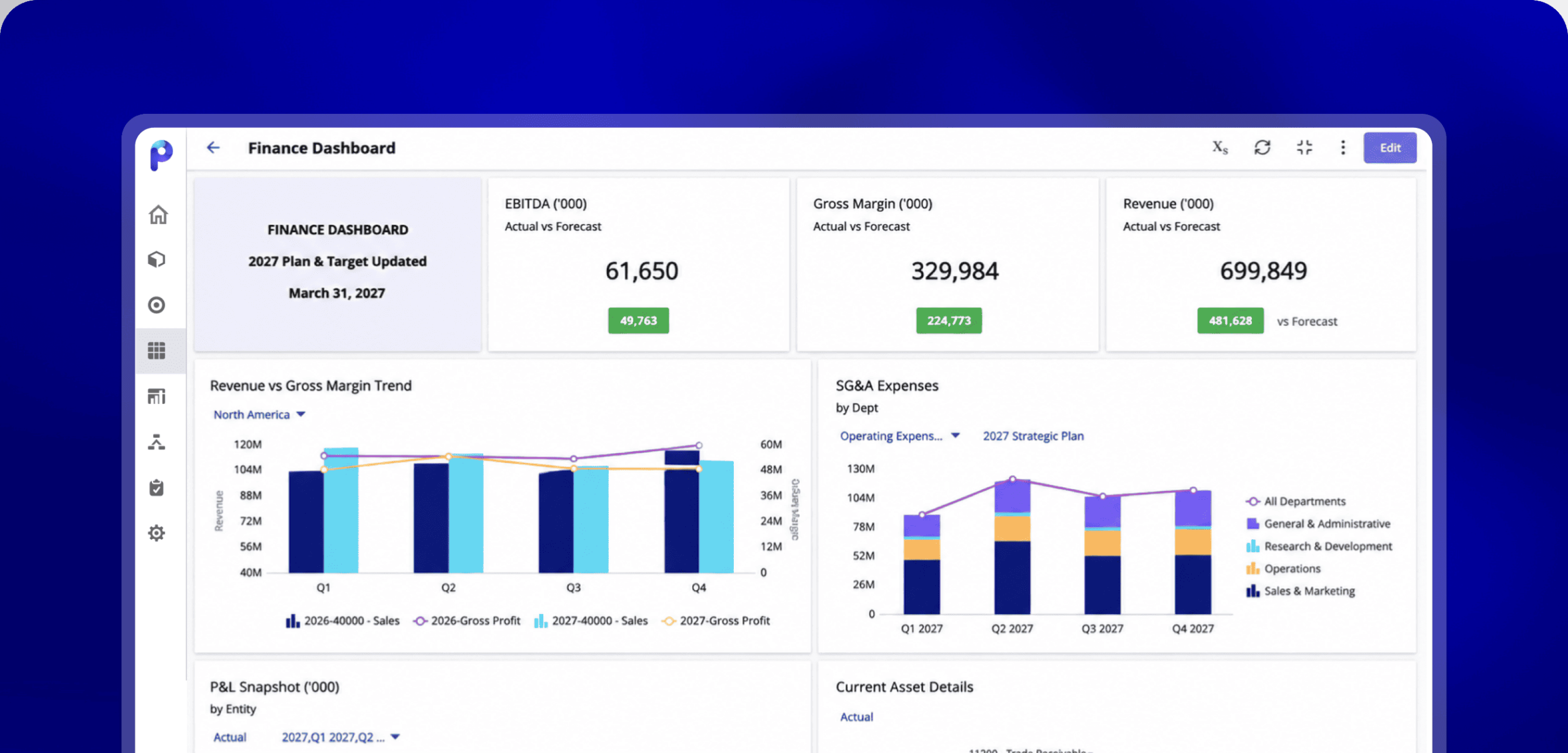
How Has AI Modernized the Financial Consolidation Process
Traditional financial consolidation required large volumes of manual work. Before AI in Finance, teams toiled with gathering data from various departments, handling currency conversions, managing intercompany eliminations, and then verifying the results.
Financial consolidation with AI introduces modernization in three key areas:
1. Smarter data ingestion and validation
AI-driven data mapping and cleansing reduces the heavy lifting of preparing consolidation datasets. Machine learning can automatically detect duplicates, inconsistent account structures, or unusual entries.
2. Automation of recurring consolidation steps
Automated workflows streamline consolidation activities including entity roll-ups, equity pickup, ownership calculations, and eliminations, bringing speed and consistency to the close.
3.Faster reporting and scenario analysis
AI for financial consolidation enables dynamic reporting and scenario modeling, allowing teams to evaluate the impact of operational planning decisions or organizational changes, delivering richer insights than traditional financial consolidation tools alone.
What are the Benefits of AI for Financial Consolidation Software?
Organizations investing in AI-enabled financial close and consolidation software can gain advantages in four major ways:
Greater Accuracy
AI detects anomalies and outliers early in the process, reducing the risk of reporting errors. It learns from historical patterns and flags entries that deviate from expected behavior.
Faster Close Cycles
Automated data collection, mapping, and consolidation can shave days off the month-end close. Many teams use AI to streamline their close checklists and enforce consistency across entities.
Improved Transparency and Compliance
AI helps enforce accounting rules, track adjustments, and create clear audit trails. This is particularly valuable for complex organizational structures.
Stronger Planning and Forecasting
Because AI enhances the quality of consolidated data, downstream activities, such as financial forecasting, budgeting, and AI for financial planning and analysis (FP&A) become more reliable.
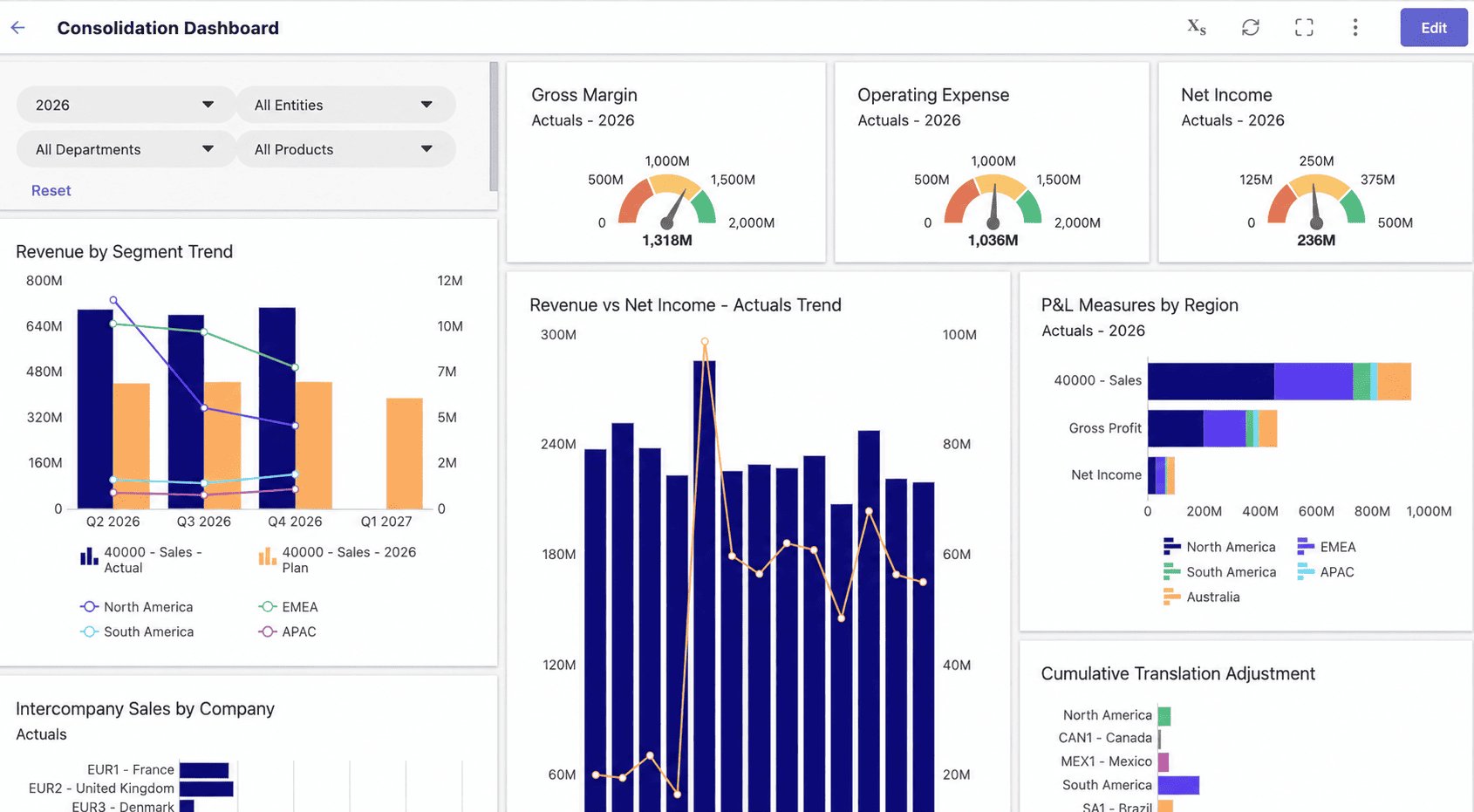
What are the Key Challenges in Financial Consolidation (and How Does AI Help Solve Them)?
Common Consolidation Challenges and AI Solutions
Challenge: Multiple data sources and formats
AI Solution: AI automatically synchronizes formats and maps data
Challenge: Slow, manual close cycles
AI Solution: Automated workflows accelerate consolidation steps
Challenge: High risk of errors
AI Solution: Machine learning detects potential errors, anomalies, and misclassifications
Challenge: Limited visibility during close
AI Solution: AI-powered dashboards and alerts can provide real-time progress monitoring
Challenge: Difficulty analyzing consolidated results
AI Solution: AI-generated insights can simplify financial reporting consolidation and scenario analysis for easier interpretation
Organizations with global operations or complex entity structures see the biggest gains, as AI reduces both workload and consolidation risk.

BONUS Financial Consolidation Checklist → Get insights on how to clear hidden bottlenecks in financial consolidation and close with this handy downloadable checklist
What to Look for in an AI-Enabled Consolidation Platform
When evaluating financial consolidation software, teams should look for a comprehensive platform with built-in AI and automation that enhances the consolidation process, rather than integrated as an add-on. The best AI enabled financial consolidation solutions offer a unified architecture that connects consolidation, planning, reporting, and forecasting in one environment. Modern financial consolidation platforms also provide preconfigured financial models to handle intercompany eliminations, multi-entity rollups, and currency translation with ease.
Real-time reporting and clear audit trails assist in maintaining compliance standards while giving teams immediate visibility into the close progress. The platform should be able to scale as organizations and teams grow. Deep integration with ERP, general ledger, and operational data sources can help ensure consistency and accuracy across the entire financial ecosystem.
Platforms like Planful Planful offer these capabilities in a unified environment, bringing financial planning, consolidation, and reporting together for a more seamless close. Explore more in the Planful Financial Consolidation Hub or review the Financial Close Checklist Financial Close Checklist to strengthen your workflows. Explore more about AI applications and AI use cases in finance.
AI for Financial Consolidation Summary
AI is modernizing how organizations manage their financial close and consolidation. By infusing automation, intelligence, and predictive capabilities into financial consolidation, teams can shorten the close, reduce errors, and gain faster access to the insights leadership needs. As AI continues to shape the future of financial technology, finance teams will increasingly rely on AI-enabled consolidation platforms, not just to close the books, but to plan, analyze, and lead with greater confidence.
You can also get an interactive demo to see Planful in action.


 Shore Capital exclusive event - Oct 15 @ [X:XX] AM ET: What Every Finance Leader Should Know About PE Reporting

